Monday, 10 October 2011

CPD23 - Thing 22 - Is volunteering in libraries the answer to all our prayers?

Volunteering is universally considered as one of the best activities that you can ever get involved with (a potential win/win for all with a supply of willing motivated workers). It is therefore not surprising that libraries and volunteers do cross paths and that volunteering is a focus for discussion and debate within the information sector.

For instance, the issue of volunteering in libraries was considered during one of the sessions at the 2011 Umbrella Conference on New Structures, New Technologies, New Challenges - How Can We Adapt To an Age of Austerity?  which was held at the University of Hertfordshire on 12 – 13 July 2011. During this session held under the 'Libraries in the Big Society' strand, presentations were made by Mike Brook about Volunteers in Libraries, Tracey Long spoke about Using volunteers in libraries - the Dorest experience and Tracy Hager spoke about using volunteers as part of the Summer Reading Challenge.

What I sense from these presentations, is that volunteering and libraries do mix and now is an important time to consider volunteering in libraries in a consistent way. As Mike Brooks says, we should use the current economic context in 2011 as an opportunity to truly consider the use of library volunteers and look at what is benefical for both libraries and volunteers themselves.

In assessing the topic of volunteering in libraries I have two questions:
  1. Why is it good to volunteer?
  2. Is volunteering good for libraries?
before providing some general concluding thoughts.


Why is it good to volunteer?


Being a volunteer has the potential of providing a range of benefits for both the volunteer and the organisation involved.


For individuals, volunteering offers the opportunity amongst other things to:


- meet new people and make new friends
- experience new opportunities and challenges
- gives you a greater sense of well-being
- get a legup in your career (or to grindhop according to Bronogh McCrudden)


For instance, in a survey conducted by the charity Community Service Volunteers (CSV), the following benefits were apparent:
  • More than 50% of volunteers perceived health and fitness benefits
  • 62% said that volunteering reduced stress
For busineses, there are also benefits.  For instance this is indicated by a survey among 200 of Britain's top businesses, carried out by TimeBank a national campaign inspiring and connecting people to give time, which found that 73% of employers would employ candidates with volunteering experience, more readily than those without and 94% of employers believed that volunteering could enhance skills.


I am a volunteer myself (currently volunteering once a week at an Age Concern day centre for people with dementia together with my dog as a Pets As Therapy visitor) and know first hand the satisfaction and value it brings to the people and staff as well as myself from something as simple as putting a smile on someone's face and speaking to people.


Is volunteering good for libraries?


YES
As highlighted in the introduction to Thing 22, library volunteering can be invaluable to people looking to find a professional post and to solve the universal catch-22 of needing a job but lacking practical working experience.

The benefits of being a library volunteer are also highlighted by Sally Hughes, guest blogger on the Voices for the Library blog. Sally speaks of being a volunteer at a museum library.

Where library volunteering is beneficial is when the volunteer's role is well defined (maybe as part of a defined project) and not acting as a wholesale replacement of paid staff. Examples might including chairing reading groups, helping to catalogue specific collections or supporting running events such as the Summer Reading Challenge.  


There are many examples of libraries using volunteers in successful ways, such as in Gateshead and Kent Library Services. Kent, for instance has had a formal library volunteer programme since 2008 which outsourced to Community Service Volunteers. Kent Libraries benefits from over 37,000 volunteer hours and volunteers work in 93 of Kent's 101 libraries. Gateshead has had a volunteering programme since 2002 and now benefit from help from around 100 volunteers involved in tasks like heritage guiding or digitising records.

MAYBE
The Public Library News website provides a factsheet on Volunteer-Run Libraries, which summarises the current list of UK public 'community libraries' and outlines the pros and cons of using volunteers to run a library service. Volunteer-run libraries are a step further than using volunteers for specific projects and tasks.

Proponents of these community run libraries see them as part of the trend to more localism in service provision (the so-called political agenda of a 'Big Society'). Specific benefits highlighted by the Community Knowledge Hub website are that volunteer-run libraries offer potential for:

NO
  • Reduced running costs for local authorities
  • Increased community involvement in and control over local services
  • Increased take-up of library services
  • Library service innovation and diversification
  • Improved access to a range of public services 
However, as the factsheet points out only 1% of current UK public service library provision is available via 'volunteer-run' libraries and this approach is 'not for the faint-hearted'.

I wonder if such volunteer-run service provision became more widespread, could these benefits really be replicated everywhere (including in less affluent areas of the country)?


Despite the personal benefits of volunteering, there are potentially many risks in relying on volunteer-led services. For instance, like it or not, volunteers come and go due to life circumstances and volunteer management is a role in itself. In the case of libraries there would be a risk of service provision and hours diminishing.


There are many people who have publically stated that volunteers shouldn't substitute the work of library professionals and I agree with them.


For instance, Liam Godfrey, Press Officer of Surrey Libraries Action Movement has said:

"Librarians are professional people and professionally trained. You wouldn’t ask volunteers to take the place of Doctors, Teachers or Civil Engineers so why would anyone think volunteers can replace librarians just like that?"


The Women's Institute, who are actively campaigning for public libraries, also share this opinion ('WI slams government over volunteer-run libraries' - The Bookseller article ). Ruth Bond, the Chair of the WI has said:


"Whilst volunteers have an important role to play, they should not be a replacement for a trained, professional library service, and local communities have real concerns about their assumed ability to take on the running of local libraries, particularly around their ability to raise sufficient funds to keep library premises running and replenish book stocks."


Final thoughts


It is so sad that we are having this debate about library volunteers but due to the economic situation and the pressures and cuts in public library budgets, I am sure that librarians/information professionals will continue for some time to come to voice the Bethan Ruddock's question of Could we all be replaced by volunteers?


I can't really imagine the UK's public libraries being replaced totally by volunteers (and as referred to above, only 1% of UK public libraries are community led at the moment so there is a way to go yet before the current public library changes totally) but who knows what some councils might try to do to libraries faced with budget cuts by 'sleight of hand' (eg Islington Libraries: The Battle Begins - 7 October 2011).
 I also believe that library volunteering should remain a personal choice compared to people faced with the threat of library closures and being forced to "volunteer" with a gun to their heads. As Liam Godfrey states "This is not volunteering, it is blackmail: taking advantage of people’s desire to nurture and protect their local community, and not wanting to lose one of the key hubs of their communities".


I also share the views of Sally Hughes (a library volunteer, herself, remember) who imagines a library closure scenario and considers volunteering:


"if my local library were to close I don’t think I would be the first person at the doors to be a new unpaid employee because without the guidance of the professionals it wouldn’t be half of what it was".


For me that says it all and why volunteering in libraries is not always the answer to our prayers either for organisations or personally.....

Sunday, 9 October 2011

CPD23 - Thing 21 - Promoting Yourself


The activity as part of Thing 21 is to consider how we promote ourselves in the job market and it really daunts me....so I am going to make an attempt to face these job promotion and hunting fears.

Paul Mullan is one particular careers consultant among many whose advice I've stumbled across online. His advice makes some sense to me at this particular moment in likening job hunting to tackling fear. He says that FEAR stands for “Fantacised Events Appearing Real”.

Paul talks about what to do when you are afraid - that you need to challenge the fear and the fact that you are creating a fantasy. You need revisit past experiences when fear was present and how the reality was very different. You need to relive the highs when you overcame fears. By facing your fears you can start to have a more positive impact in searching for a job.

I can't absolutely say I think this way positively yet, but I do understand that my current approach to job hunting is beset by 'fear hurdles' which need to be overcome.

Part 1 is to look at our own career and identify strengths and weaknesses


"Tell us about your greatest strengths" is a very common interview question. Why then that so many of us find it so difficult to answer?

Book title says it all!
Like many others, I probably fall into what Paul Mullen describes as the 'the pit of self promotion'. In other words I have an under performing CV because I tend to hold back on highlighting key achievements or successes because of a lack of appreciation of the bigger picture and fear of being boastful.

To address this will take some time and as a first step I need to develop  an achievements log (maybe as part of an extended Revalidation portfolio activities log.


Part 2 looks at CV writing


I have a CV and it works (or has worked) adequately, but after over 3 years in my current job it definitely needs a dusting off now. I'm aware that the approach to presenting CVs has changed in recent years and it is interesting to learn of new techniques and approaches rather than the chronological work based approach that I continue to use. Presentations about CV writing such as Really Ugly Resumes and Resume Zen provide food for thought.

Did you know that in general it can take recruiters as little as 10 seconds (not surprising given CV filtering software) in some cases to judge what you are like from your CV?

It's therefore important that we take the time to think very carefully how we present ourselves in the best light and in a way that stands out from the crowd.

Part 3 looks at job interviews


As Paul Mullen states, the final task in job hunting is the 'dreaded interview'. He advises that the best way to tackle this fear it to PREPARE. This is also the advice from many other people and sources including CILIP which provides Going for an interview - Top Tips.

I've been to a couple of interviews in the past year or so and I find them more nerve-racking than ever. However one thing that does keep me going is an awareness that the interviewers are just as nervous as the interviewee. I've been fortunate to sit on an interview panel and to see first hand how the process works from the other side of the desk. As an interviewer I have found myself willing candidates who are under performing to explain themselves more and show themselves in the best light possible.

Lastly, I found the attached skit from the BBC 2 TV show "Mock the Week" funny. It's all about what not to say at job interviews......


Thursday, 6 October 2011

CPD23 - Thing 20 - Library Career Routes and Wisdom

Career Paths
If you are anything like me, then anything to do with career planning, career pathways, careers guidance and careers advice seems very daunting.

This is where both the Library Routes Project and the Library Day in the Life Project are such great ideas since they help to demystify some of the nature of what working as a modern day information professional involves.

Our perceptions of careers and jobs are built by our own unique mixture of experiences and by talking to friends, family, parents and teachers, learning from the media (TV, newspapers) and from reading online and books. Existing perceptions and prejudicies can be very hard to shift. Therefore these two website resources are as Laura Woods says in her overview to Thing20,  "intended to shine a much-needed light on the types of jobs and career paths available within the information profession".
I have previously contributed to the Library Routes wiki already - see my blog post to CPD23 - Thing 10 - Routes into Librarianship.
Do you think your own path was typical or unusual compared to others?
Having a nose around at other contributions, I'm probably one of the few people who actively pursued a career in library and information work, compared to most other contributors who seems to have stumbled a lot more into this career path.
I'm also one of very few contributors from a government or special libraries background (not because there aren't people like me out there but presumably because less people working in these areas are aware of the wiki).
This raises the question of what we can all do to actively promote what it really means to be an inforamtion professional and the value of information management and libraries beyond what Ned Potter and Laura Woods call the 'echochamber' of talking about being a librarian and libraries to ourselves.  That battle is not yet won!

Words of advice
True words of wisdom!
My first top tip is that if you get the opportunity, do try to find a job via the CILIP graduate traineeship scheme.
This is beneficial to both employers who are seeking enthusastic graduates looking to find experience in information and library work. It also works vice versa for those same graduates who are looking for real-life working experience to demonstrate work commitments and to start to earn money. CILIP clearly indicate that those who are successful in securing a traineeship are looked on favourably if they then decide to apply for a CILIP accredited course. You have to be organised in applying for these roles, but opportunities do appear throughout the year and they are very varied to suit all personalities and backgrounds (and maybe get your foot in the door with an employer). They are also a competitive job-seeking process, so be prepared for submitting your CV and interviews. To get an idea of some graduate trainee schemes you can check out the websites run by graduate trainees working at Cambridge University (CATALOG), OWL: Oxford Website for Library Trainees and the Albert Sloman Library Assistant pages. Remember these are only three possibilities from around 70 opportunities advertised annually.
Being a graduate trainee definitely helped me with Plan A - ie applying for a Masters in Information Management and finding a full time job.
However, you should also always be prepared for a Plan B (or even C or D) as you come to appreciate the older you get that life is not always straight forward and plain sailing.
By the time you have been around for longer in an organisation and you get associated with a particular job, position or role (particularly if you work in a larger organisation), the more closely you are associated with your existing skillset. For all the talk of the possibility of changing sectors, I personally think that unless you move around when you are a 'newer' or 'younger' professional, the harder it will be disassociate yourself from your perceived skillset later. Be prepared to reach an invisible 'glass ceiling' mid-point in your career and plan for that.
Whatever propelled people into their current situation, I'd also advise everyone to:
  • continue to keep flexible and current with new technologies and ways of working
  • volunteer to undertake new work and activities
  • be positive as long as possible and avoid listening to cynical voices
    Wish I had one of these!
Also be open to all the wisdom of others. Here are some words to ponder:
  •  "Analyzing what you haven't got as well as what you have is a necessary ingredient of a career" - Orison Swett Marden
  • “I've missed more than 9000 shots in my career. I've lost almost 300 games. 26 times, I've been trusted to take the game winning shot and missed. I've failed over and over and over again in my life. And that is why I succeed.” - Michael Jordon
  • "What is the recipe for successful achievement? To my mind there are just four essential ingredients: Choose a career you love, give it the best there is in you, seize your opportunities, and be a member of the team.” - Benjamin F Fairless


Monday, 3 October 2011

CPD23 - Thing 19 - Catching Up

Reflection
This is the second time that the CPD23 Things course has dedicated a specific time and space for participants to reflect (the first time being Thing 5 way back in July 2011!)

This time, however, we need to think about each of our previous posts and consider:
  • what elements were most useful
  • how you could integrate them into working routines
Throughout the course we have covered:
  • social media tools (blogging, RSS feeds, Twitter, LinkedIn)
  • productivity tools (Evernote, Google Docs, Wikis, Google Calendar, Mendeley, Prezi, Jing, Podcasting, Screencapture software)
  • professional development (personal branding, reflective practice, advocacy, events, networking, mentoring)
Here are my thoughts in these elements:
  • Blogging
The first element to reflect on is blogging, which underpins this whole course. Since Week 1, I feel more comfortable writing my thoughts for public consumption. Still not sure anyone is listening but like the therapy value!

Given the work I do, I am still not sure whether I will be to blog in an official work capacity although my department now have a departmental blog (which includes contributions from Ministers and policy officials) and there might be an opportunity to contribute to this in some way in the future.

I am now starting to think about what to do after the end of CPD23 Things ends and will share some thoughts separately.
  • Social Media tools
I already used all of the social media tools (with the exception of Pushnote) before the course in either a personal or work capacity. I've started to use Twitter and RSS feeds more personally (both following others) and building up more own followers via my work and personal accounts.

Since Thing 6 about online networks, I've actually signed up to Google +. Not sure how much use this will be until friends, colleagues and family also start to use as well - I'm virtually billy-no-mates at the moment on there! I also noted with interest, the changes to Facebook's news feeds in early September (in response to the launch of Google+ beta version), and I have monitored some of the comments and feedback shared by others about these changes.
  • Productivity tools
Most of these tools were unknown to me before the course. I've particularly enjoyed exploring using Prezi, podcasting and screen capture software which will be useful at work as part of my communications/awareness raising role.

I've downloaded a few of the tools including Evernote and Mendeley but not really had a chance to use them properly. I'm still most excited about using Mendeley to manage and group my PDF documents. I've also been recommended to download Camtasia (a premium screen capture software) which I intend to explore using as well.
  • Professional development
The CPD23 Things programme generally has been a great opportunity to reflect on things I've achieved and where I can support others. I made a commitment to put my name forward to become a CDG Chartership Liaison Officer - something I've only just done - so great to be reminded.

In summary, I think most of the elements of professional development have a potential impact on my working routine in making me more motiviated and conscious of how I work with other people. Understanding your impact on other people is very important in helping you to progress and grow in life (professionally and personally).

Thursday, 29 September 2011

CPD23 - Thing 18 - Screen Capture and Podcasting

How to summarise Thing 18 to an IT illiterate person?

Podwhating, indeed!!!

Initially both words sound very odd and confusing.  In essence, both are simply about using online web tools to communicate.
Depending on the context both tools are very appropriate for my work in engaging with business about export control (and I am sure they can be helpful in your work or personal context too if you can think creatively). I've actually considered using podcasting already, so Thing 18 is definitely helpful in sparking ideas of how to take things forward in reality.

What is 'screen capturing'?

"If you can see it, you can capture it" is the slogan of a piece of screen capture software.
This is the functionality or process of capturing or recording a person's interactions on screen. Screen captures are sometimes referred to as screenshots but in fact they are a short video which some people confuse wrongly with video editing (ie involving a camera). However screen capture does not need a camera - just you and the relevant software (either free, bought, online or downloaded).

It is useful for recording what you might do to navigate a series of website screens (which might be a great alternative to providing a lengthy text description - instead you can share a short video which can be uploaded to YouTube or another website who to actually use a website or piece of software online).

Overview of Picasa - Screencapture video

To demonstrate what you can do with this type of functionality, I produced a short 'screen capture' about using Picasa, a brilliant image organising software tool.
This is exactly the type of short instructional video that is potential useful for my work in explaining how to use websites and databases. It is a real great alternative to a standard text guidance document.

I used Screencast-o-matic, a free online video recorder, for this and found it provided:
  • clear instructions - countdown to recording - 3,2, 1, go! 
  • stop and start buttons clear
  • logo on free version not very obtrusive
  • has option to restart recording 
  • adjustable screen capture window
  • good clear audio sound recording
so it quickly and very easily did the job I wanted. The trick in preparing a screen capture video is to prepare a properly drafted script (to avoid embarrasing UMs and AHs and random pauses) particularly if the video is to be uploaded onto a professional website and this might take a bit of practice.

Ultimately good instructional videos using screen capture tools also hinge on a good audio ie obtaining a proper microphone rather than an inbuilt PC mic.

What is 'podcasting'?

noun -- a multimedia digital file made available on the Internet for downloading to a portable media player, computer, etc..
verb (past and past participle podcast) [with object] - make (a multimedia digital file) available as a podcast.
(Oxford Online Dictionaries definition) - http://oxforddictionaries.com/definition/podcast


This is the process of producing a series of audio broadcasts which are published online. Some people confuse a podcast by associating them with single one-off audio programme or recording. However the key feature of podcasts are that they form a number of episodes which can then be updated and shared via a feed (which people can subscribe to receive online).

There are 4 stages to producing a podcast
  • pre-production (ie planning what to say)
  • production (ie recording)
  • post-production (ie editing)
  • publishing (ie upload to website and alerting people to the information where they can find it) 
As with screen capturing, good podcasting hinges mainly on the pre-production statge in preparing a well-drafted and thought out script (beginning, middle, end). I therefore am aware that podcasting is potentially beneficial in schools and teaching settings in helping in language, comprehension and communication skills.

Podcasts and Government Communications

Podcasting is also a great way for governments to communicate (admittedly one-way but in a manageable and potentially more engaging way rather than via screens or pages of writing). Podcasting's biggest asset is that it uses the power of talk.

Some great examples of UK public sector organisations and departments already using podcasting are:
However, this is just the tip of the iceberg and there is certainly scope for the UK government to use podcasting more strategically. (Note: I can't locate a single consolidated list of all government podcast feeds although the Australian government do helpfully provide a listing!)

Back in 2008, Simon Wakeman, who works in communications and marketing at Medway council, reported that approximatly 32% of local councils were planning to use podcasting in the next six months. I would presume this figure would have gone up somewhat in the intervening years, however, from my own experience there are plenty of untapped opportunities for using podcasting (or indeed other forms of social media).

The trend towards greater use of e-media tools (such as podcasts) is already more obvious, given the financial cuts and is long predicted in IT and media circles.

For instance, the professional service firm, Deloittte produces an audio news podcast called Global Insights which looks at issues affecting the global business community. One of this series has focused on E-Government trends which are seen as moving from an option to an obligation. Deloitte predicted that in 2011 (and I am sure beyond as well) that e-government tools would increase significantly. One of these tools is undoubtedly the podcast itself, which offers a cost effective way to communicate online with a wide range of audiences.
The UK's People and Participation.net website helpfully give some practical examples of podcasting's potential uses in a public service context - such as recording council meetings, interview leaders, audio tours of city, explanation of business services, highlighting case studies.

It highlights the advantages of podcasting for government (locally and nationally) as a cost effective communication mechanism (using at minimum a microphone and some free software). However, to work effectively in the long term podcasting really needs to be thought about in the context of other communication methods.
The challenge for government organisations (across marketing and policy teams) is to ask:
  • what is the value of audio communication?
  • how does a podcast fit with other communication methods?
  • how will we manage any issues surrounding use of tools eg queries about cost? senstivity of topic matter?
  • who is the target audience?
  • will a podcast on particular theme generate sufficient interest?
  • how does podcasting change our communication with our audience?
  • is business doing something similar or better and are we wasting our time?
  • how will we measure and evaluate its success and compare with other communication methods?
  • what skills do we need to make podcasts?
    • Oral and Communication Skills - writing, listening, questionning, drafting, reviewing
    • Teamwork Skills
    • Presentation Skills - preparing structured information designed to meet audience need
    • Analysis Skills
    • IT Skills - editing software

Just part of the communications mix....

Screen capturing and podcasting are not rocket science (damn - just done myself out of a job!). However, I'm sure that most people are not aware of these communication mechanisms (and need handholding). There is therefore a lot we can do as information professionals to educate our colleagues and push forward with some practical examples of how these tools can help share the messages we want to communicate collectively for the benefit of our organisations and our customers.

Saturday, 24 September 2011

CPD23 - Thing 17 - Presentation Software 'ology'

Despite a week or so with no CPD23 Thngs related posts, I am still keeping up with the activity programme. Thing 17 was slightly delayed in being published and I wanted to wait until this appeared so that I could keep with the proper sequence (since I like orderliness).

Give yourself a pressie (or should that be 'Prezi')

Prezi is a popular piece of presentation software which enables you to create dynamic (sometimes rather seasick-inducing) presentations that are not bound by the limitatations of a slide pack as with Powerpoint and similar tools. Its power is in demonstrating connections and is potentially more visual if used well.

Here is my first attempt at producing a Prezi-based presentation:

Prezi compared to Powerpoint

As a first time user, I found Prezi quite difficult to manipulate and you definitely need to take time to plan and think through the structure. Some of the downsides are that there is no spellcheck, limited font and editing capability. There are also the usual plusses and minusses of being available only online.
Having said that, Prezi is cool and innovative. It offers a refreshing alternative to the problems of Powerpoint which include the following:
  • screens detract from eye contact with your audience
  • reading and listening is distracting
  • slides as crutches
  • information overload
  • wordy and bullet points
It's hard to believe that it is over 25 years since Powerpoint was first devised. The idea was developed by Robert Gaskins and Dennis Austin, two employees of a company called Forethought back in 1984, before eventually being bought out by Microsoft. Powerpoint now represents almost a 95% share of the market with over 500 million users worldwide and businesses make an estimated 30 million powerpoint presentations each day (facts and figures from BBC website article on 'The Problem with Powerpoint').
No wonder with Powerpoint's reach globally in business and organisational life, people feel frustrated and are keen to seek alternatives. That's human nature. In fact that's why Powerpoint developed in the first place - as an alternative to overhead projectors and acetate sheets (remember those?) and flip charts. (As an aside you might like to know that it was reported in the Guardian on 28 August 2011, that there is an Anti-Powerpoint Party (APPP) in Switzerland who want to outlaw the software).

How to improve the lost art of presenting

While I can sympathise with the APPP,  we have to remember though, that presentation tools are only that - if people are bored by Powerpoint (or other presentation software packages) then is it really the fault of the tool? People are bored by people.
Powerpoint used sparingly and in a considered, structured way can be very powerful. I'd agree that creating presentations is an art and a science. Too many people put no creative thought into the process. But when they do the results can be very appealing and engaging.

This is where I'd recommend everyone to read either:
  • Slide:ology : The Art and Science of Creating Great Presentations by Nancy Duarte (who created the Al Gore slides for the film an 'Inconvenient Truth' and who blogs at the Duarte blog)
  • or alternatively Garr Reynolds's book Presentation Zen (who blogs on professional presentations at the Presentation Zen blog).
These books both advocate a more creative visual way of delivering presentations. You can read a review of both books on the Powerpoint Ninja blog.

To see what we are all missing I took the following title to heart and include as an example of the potential of great presentations (rather than the bad or the ugly).
STEAL THIS PRESENTATION!
View more presentations from @JESSEDEE

I don't think Powerpoint presentations will die yet given their ubiqutousness, despite the advent of new presentation tools like Prezi (and Google Docs, Sliderocket and others). However we should all do our best to think carefully about audience friendly presentations, bearing in mind scientific opinion and research about cognitive neuroscience which should inform our delivery of presentations (See 'The Scientist' article 'Pimp your Powerpoint').

Maybe there will be a way of integrating Prezi into Powerpoint (if they are bought out by Microsoft?) so we get the best of both tools....and that idea is already taking shape in the form of pptPlex, which is a Microsoft beta version addon that provides similar Prezi-type functionality, although this because it is a test version it has limitations (such as not allowing videos to be integrated into your presentation).

When neither Prezi or Powerpoint will do

It also seems ironic that in this most media orientated of ages we seem to have lost the art of public speaking and delivering confident presentations. As a result, as the journalist Cory Franklin highlights in his article 'Powerpoint: the kudzu of modern communication' bemoaning its dreary reach and strangling of human communication, we seem to value a young novice with highly developed technical skills appears more seductive than a far more polished communicator but who lacks the technical know-how.

In some circumstances we should remember however, that no presentation IT software tool will do. Just imagine our political leaders delivering their major speeches using either Powerpoint or Prezi regardless of their merits in context. Can you really picture when Winston Churchill gave a major war speeh going 'Click' - Next slide: "We shall never surrender." It would never have worked......

Where information professionals can help

As Ned Potter, the Wikiman has shown with his creative Prezi based presentations (such as Escaping the Echochamber), information professionals can aid their organisations in marketing and communications skills (and of course in directing people to using the right tools in the right context). We should continue to seek out these new tools and weigh up their pros and cons to make sure they serve our organisational and personal purposes.

Sunday, 4 September 2011

CPD23 - Thing 16 - Library Advocacy and Activism

Confession time - I don't consider myself to be either a library activist or advocate. I mean this in the narrow sense that I am not very vocal and active in proclaiming the benefits of library and information services (surely not the only one who admits to this?). This doesn't mean that I don't think this issue is unimportant though....

More than just buzzwords

Over recent years, however , more and more librarians (including many new professionals) are defining themselves as activists  - in the UK people like Johanna Bo Anderson, Maria Cotera, Ned Potter aka the Wikiman and in the US people like Jessaymn West ('putting the rarin back in librarian'), Alan Molaro (whose blog is the Information Activist Librarian). I envy their enthusiasm, passion and commitment.
WI campaign for libraries
In response, CILIP (who could be accused of not being active enough in this area) are now taking more active steps to focus on advocacy as one of its main roles. One great win is to get the support of the Women's Institute who have adopted libraries as its campaign in 2011.

The idea of information activism is not entirely brand new (witness Dale Carnegie and others from the past), but now in the face of market pressures, political and economic pressures due to recession, competition from online sources and behemoths (the mighty Google and fast nimble new internet service providers), librarians are realising that they need to take more active steps to promote and market themselves and move out of what Ned Potter labels the echo chamber (where librarians are simply talking to each other instead of marketing a message to people outside).

Activism and me

To date as I indicated above, library activism has passed me by somewhat, so to speak. Not sure exactly why. Maybe its because fortunately none of my local library services have been directly affected yet by cuts or have developed an active Friends network of supporters (and people generally become activists eg in climate change most often when they are directly impacted personally).
However, this might change as my local council is currently conducting a review of the library service (which it would be naive to think won't emerge unscathed). If my local library is threatened, I would like to think that I could and should do something, although what I don't know exactly.

Despite this, I have got active in some small ways. For instance, on 5th February 2011, you might remember we had a national Save Our Libraries Day in the UK. CILIP encouraged as a minimum that people borrowed items from the library and this is what I did, but I was kind of frustated and felt it would have been more fulfilling to have done more. I therefore look forward to 2012 and the launch of National Libraries Day and seeing if I can do more.

Be the change

It is said that charity begins at home. Likewise with advocacy and activism which are both like ripples, that spread out from individuals who are inspired, motivated and empowered to connect with others.

We should therefore all look at ourselves and ask whether we are each doing enough to shout loudly and speak up for the work of libraries and information professionals. Getting published is one way to do this but it is often easier said than done.

Why is it for instance that when library closures and campaigns are reported in the press, that there are always authors interviewed but never librarians? This annoyed so much a few months ago in a piece on BBC Breakfast that I wrote in to the producers to complain.
The future of libraries and inforamtion professionals?
Clearly, journalists have their own agenda and visions of how to report a story. Too often they go for cliche, something that will attract maximum attention and therefore alight on people who can sell a story, such as authors due to their fame because they are more in the public eye.

Simple actions we can all take

I think we all have a role in advocating the changing face of libraries and information professionals away from the usual unrepeatable cliches. That means each speaking to all friends and family about the value of libraries and information resources. How many of your immediate circle actually use a library at all?

There are also some really simple steps that we can take (as suggested by the Women's Institute Love Your Libraries campaign:
  • to carry and USE our library cards with pride.
  • sign the Petition in support of public libraries on the Government's e-petition website. Any petition that has over 100,000 signatories will trigger a debate in Parliament.....there are only 7,000 signatories so lots of support is still needed.
  • write to your local MPs and councillors to say how much you value your local libraries (and yes they will reply back from previous experience).
Also not forgetting the very worthwhile forum Voices for the Library which you should all check out for further ideas and campaigning tips.

General thoughts on being an activist

In getting involved with being activists/advocates, I think we have to recognise what success looks like, how it happens and how people interact and work together. Successful advocacy and activism is built on:
  • People
  • Passion
  • Partnership
  • Planning
  • Promotion
and this depends on individual and organisational values and culture.

As Johanna Anderson says in her blog piece on activism, we should all be advocates (or as I would put it we should all share our passion and enthusiasm). Activism goes beyond just passion - it is about hard work and doesn't just happen overnight. It means being strategic and being aware of other people, attitudes and opinions and knowing when to act or behave in certain ways ie be strategic. (Basically we need to recognise which projects and campaigns are worthwhile pursuing and which are not).

Advocacy and activism in government departments

I've mainly referred to advocacy in the context of public libraries which seem most embattled in modern 2011 austerity Britain. However, advocacy is also needed within government libraries as well. Government information professionals are needed for many reasons because they help oil the wheels of good government by:
  • storing and using data effectively so that it is properly protected, accessible as required, and easily available to support good decision-making.
  • directly impacting on government cost opportunities: the Office of Fair Trading has estimated that stimulating and facilitating the re-use of public sector information could potentially contribute £1bn to the UK economy per year
  • enabling policy officials to have the information available to do their job eg a permanent secretary knowing information is secure, efficient handling of Freedom of Information requests and collaboration between teams.
Many government information service units/libraries have already learned the hard way to change or face cutbacks and have learned that they need to work to promote themselves on a more strategic basis to colleagues.

Its for this reason that in December 2008, the government published a knowledge and information strategy document called "Information Matters". This is an action plan to guide government in better use and management of knowledge and information. However my feeling is it still needs promoting across government departments. (An advocacy gap here, I think!)

However, time moves on and now all government departments face huge internal organisational changes. There is therefore a risk that "Information Matters" is forgotten in a maelstrom of other activities. At the same time I fear it is becoming all too easy to sideline librarians and information professionals who might not seem to represent the core work of a department eg policy work.

Amidst these change pressures it is important for professional civil service groupings (such as the Knowledge and Information Management Profession) to have a well organised, supportive and active Head of Profession. I don't get this sense of direction or support from within my current department. Additionally while there are senior groups in place (the nebulous Knowledge Council) in government, I don't get any feeling of how this impacts on me on a daily work basis. ((Probably another role for me to advocate internally, there!)

Library advocacy pictures say it all.....

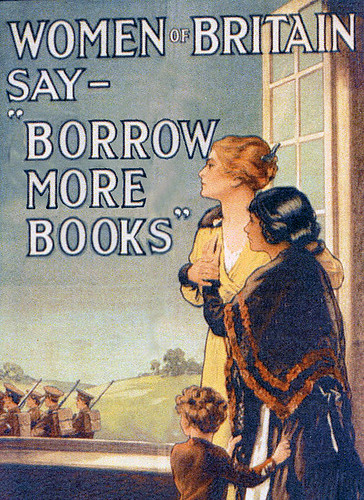
Pictures convey much more than words as these posters show - they convey powerfully what I want to say but far better:
Vintage poster campaign to Love Libraires created by Phil Bradley

Washington State Library Marketing Initiative

PS..

I recognise this posting might not be very coherent....I should have labelled it 'random ramblings', but CPD 23 Thing 16 does give me (and I hope others) lots of food for thought about what more I (and we all) can do personally to ensure libraries are not taken for granted and thrown to the wolves just because they are easy targets.
Powered By Blogger